July 1, 2026
The Token Was Always Code
Figma Code Layers don't kill design tokens. They prove why tokens matter more than ever.

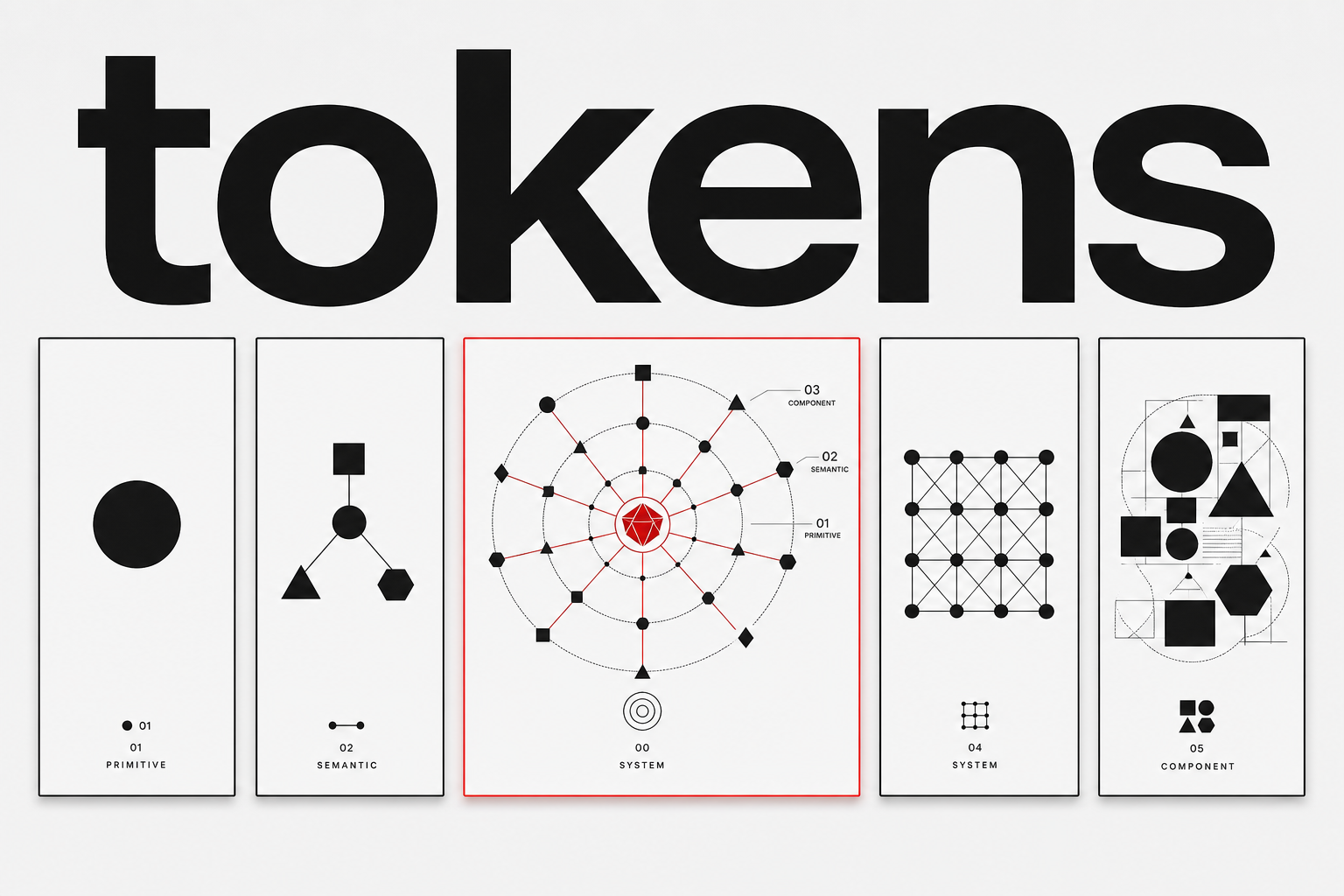
I’m building a design system in Figma right now. Not designing screens. Building the system that builds screens. Ninety-three variables, every color bound to a semantic token. Ten text styles. Eleven components. The pipeline is deliberate: Figma variable → design token → CSS custom property → component code. Months of work, all organized around the idea that the token is the source of truth and the code is the output.
Then Config 2026 happened.
Dylan Field walked on stage and said: “Code is not the opposite of design. Code is material for design.” Then he showed Code Layers: any design frame becomes interactive code with a prompt or a click. Duplicate it. Iterate on it. Comment on it. Treat it like any other layer on your canvas. It’s in closed beta for now, but the direction is unambiguous.
I stared at my variable collection and asked the obvious question: if a Figma layer is code now, what exactly am I spending months building tokens for?
What Code Layers actually does
This isn’t Figma-to-Code export. That’s been around for years and has always been mediocre: pixel-perfect screenshots wrapped in absolute positioning, useless to any real engineering team. Code Layers is something different.
It’s a layer type. A first-class canvas primitive, sitting alongside frames, text, and vectors. You can extract design frames from a GitHub repository. You can convert any design layer into working component code with a prompt or a click. You can go the other direction: pull interaction flows out of code and inspect them as design layers. It’s bidirectional. The handoff pipeline doesn’t get faster. It dissolves.
Think about what that means for a design system. Today, the workflow is: design a component in Figma → document the tokens → write the code → test the code → find inconsistencies → update Figma → repeat. With Code Layers, you design a button variant, generate the code, and see immediately whether it respects the system. The gap between designing and verifying closes to zero.
What tokens do that Code Layers can’t
A Code Layer gives you this button as a component. The exact element, on the exact screen, in the exact state you designed. Beautiful. Precise. And also: a point solution.
A token system says something different. It says: every button across this entire product, on web, on iOS, on Android, in light mode and dark mode, in every component library your team maintains, uses this exact primary color, this exact spacing scale, this exact border radius. Not because someone remembered to copy the value. Because the token is the contract. Change the token, change every instance. Every platform. Every mode. Automatically.
Code Layers solve the translation problem. Tokens solve the consistency problem. They are not competing. They operate at different altitudes. A Code Layer without a token system is a beautiful one-off: precise, fast, unrepeatable at scale. A token system without Code Layers is a promise you still have to verify manually.
The real power is when they meet: a Code Layer that inherits from your token system. Generate the code, and the button already knows it’s bg-primary, not bg-blue-500. Already uses spacing-3, not 12px. The token was there before the code existed. The code just surfaced it.
Figma’s playbook
There’s a pattern here. Figma has been eating the layers between design and production for a decade.
In 2016, prototyping moved into Figma. Suddenly you didn’t need InVision or Marvel (standalone prototyping tools) to show a flow. The prototype lived on the same canvas as the design.
In 2019, developer handoff moved in. Inspect mode, code snippets, measurements. Tools like Zeplin and Abstract, which existed solely to bridge design files and engineering specs, became optional. Each time, the tool absorbed what sat between the design file and the shipped product.
Code Layers is that absorption reaching the final mile. Not the handoff. The build itself.
If the pattern holds, the thing that distinguishes designers won’t be their ability to operate Figma. It will be their ability to define the rules the code follows. Tokens. Component architecture. State management. The things that live above any single screen. The things that make a system a system.
Two kinds of designers
After Config 2026, there are two kinds of designers.
Type A pushes pixels. They’re fast in Figma. They know every shortcut. Their frames are beautiful. Their job ends at the Dev Mode handoff. They trust the engineers to figure out the rest.
Type B understands component architecture. They know why a token system has tiers: primitive tokens feed semantic tokens feed component tokens. They can read the output Code Layers generates and spot when a color is hardcoded instead of inherited. They don’t need to write production code, but they can have a real conversation about component composition with an engineer. Not a handoff. A conversation.
Type A isn’t bad at their job. They’re skilled, precise, and their frames ship. But the part of the job they’re best at: translating designs into specifications for engineers, is exactly what Code Layers automates. That’s uncomfortable to hear, but it’s true.
Type B has been investing in the layer above. They think in systems, not screens. A button isn’t a rectangle with a label. It’s a set of rules: what changes, what doesn’t, what inherits, what overrides. Code Layers doesn’t threaten that skill set. It amplifies it.
The question isn’t which type you are today. It’s which type you’re building toward.
The invisible code
Here’s the thing Figma’s framing quietly obscures: the token was always code.
A CSS custom property is code. A JSON token file is code. A design token specification, whether it’s the W3C format, Style Dictionary, or Tokens Studio: is code. It’s declarative code: it says what should be true. It doesn’t execute. But it’s code all the same.
What Code Layers introduced isn’t code entering the design canvas. It’s imperative code entering the design canvas. Code that renders. Code that responds to state. The declarative code, the tokens, was already there. It was just invisible to anyone who didn’t think of it as code.
The split isn’t design versus code. The split is declarative system versus imperative instance. And the declarative system, the token architecture, is what makes the imperative instances consistent, composable, and scalable. Without it, every Code Layer is an island. With it, every Code Layer inherits the continent.
The better job
Tokens don’t become redundant after Code Layers. They become the grammar that makes Code Layers useful at scale. You don’t stop designing tokens. You design tokens, and the code inherits them. You change a spacing variable, and every Code Layer across every screen updates. You add a dark mode value to a color token, and every generated component knows what to do.
The designer’s job shifts from “translate this frame to code” to “define the rules the code follows.” That’s a better job. It’s harder. It requires knowing how components compose, how systems scale, how a change at the primitive level cascades through an entire product. But it’s also the job that survives automation. Because defining the rules: deciding what should be consistent, what should flex, what should adapt, is a design decision. Not a translation task.
The token was always code. Code Layers just made it visible.