August 16, 2026
Stop Designing Screens. Design Decisions.
Screens go stale the moment you ship them. Decisions compound. The deliverable was never the file. It was the call behind it.

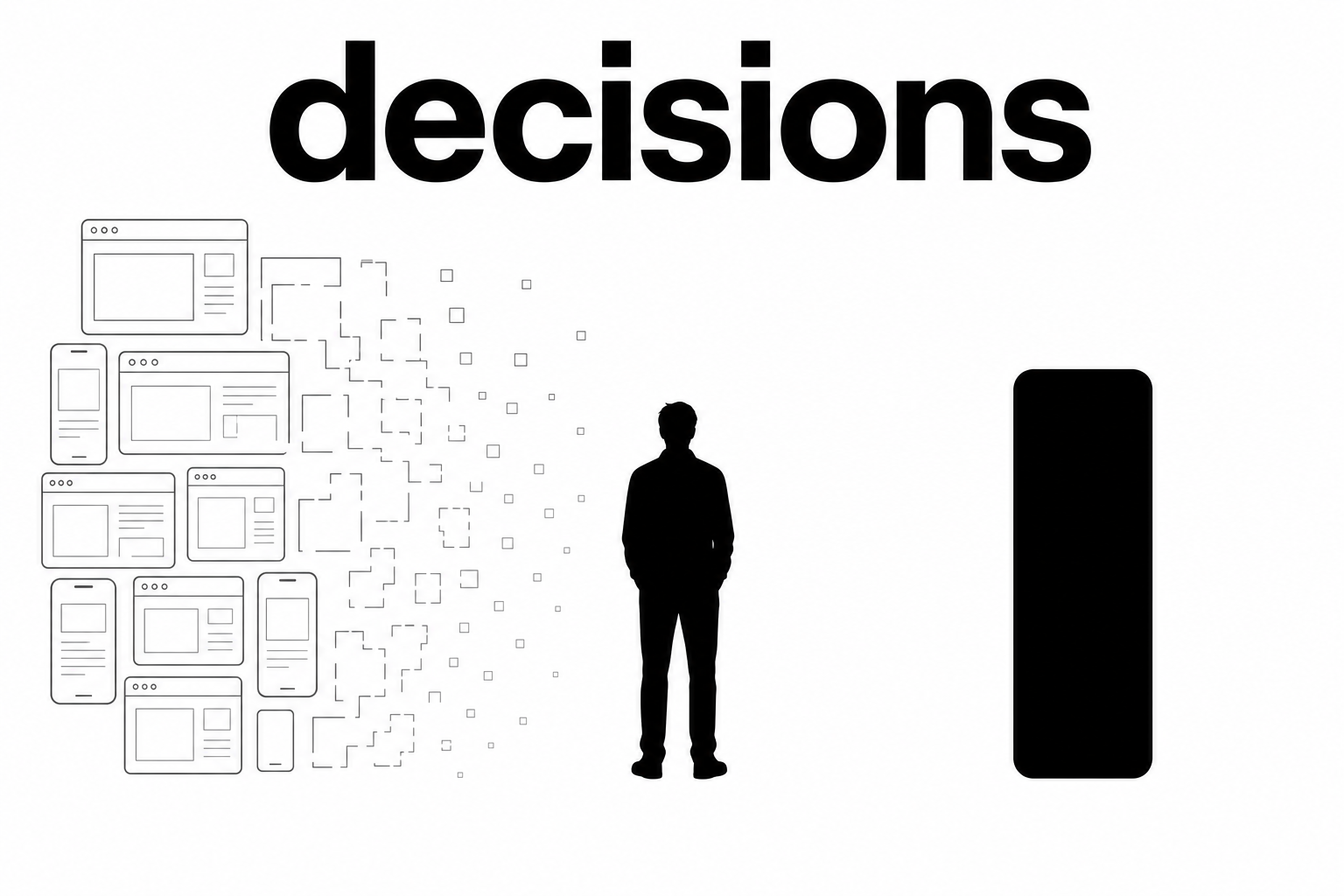
I’ve spent twelve years drawing screens, and here’s the uncomfortable truth: almost none of them survived.
The dashboard I designed at my first real job is gone. The onboarding flow I polished for three weeks was redesigned within a year. The design system I built at my last company got rebuilt after I left. Screens are sandcastles. They look impressive, then the tide comes in.
What survived was the decisions.
Every screen I’ve ever made was a decision wearing clothes. “The primary action sits on the right because that is where the thumb lands.” “This setting is hidden behind a modal because it gets used once a year.” “The price comes before the features because price is what filters out people who were never going to buy.” The screen was just the cheapest way to communicate that call. The call was the product.
Screens are the cheapest part
A screen is a snapshot. It goes stale the moment you ship it. The market shifts, the user learns, the product changes, and the screen you agonized over is now wrong. You can fight that by endlessly updating screens, which is what most designers do for most of their career. Or you can accept that the screen was never the point.
A decision is the opposite. A good decision compounds. “We prioritize speed over customization” does not expire when the design system gets rebuilt. It is the reason the next system gets built that way. “We optimize for the repeat customer, not the new visitor” survives three redesigns and a rebrand. The decision keeps paying.
This is why senior designers talk less about pixels and more about why. It is not that they lost interest in craft. It is that they learned where the craft actually lives. The pixel is the last five percent. The decision is the other ninety-five.
The decision is the deliverable
When I look back at the projects that actually moved a product, the artifact that mattered was rarely the mockup. It was the tradeoff.
A real one. I was designing a settings screen for a product used by thousands of small businesses. We had two options. Option A was faster to build and looked cleaner. Option B was slower and messier, but it put the user’s data where they had already learned to look for it. The Option A mockup was beautiful. The Option B mockup was fine. But the decision we actually shipped was: “we take the slower, messier option, because consistency beats novelty for this user.” That sentence changed what got built. The mockup just illustrated it.
A decision is a reusable unit. It gets referenced in the next project. It gets quoted in the next argument. It outlives the tool it was made in, the company it was made for, and the person who made it. A screen does none of that. A screen is disposable. A decision is durable.
If you want to know what a senior designer actually produces, do not look at their portfolio. Look at their decision log. The options they rejected and why. The constraint they chose to respect and the one they chose to break. That is the work.
One thing I will keep short, because it is not the point. AI sharpens all of this but does not change it. The models are getting better at proposing decisions, yet they hallucinate and state their wrong assumptions with total confidence. So judgment has not gone away. It moved, from making every call alone to catching the bad one. None of what follows needs AI to be true. It was true before the tools got good.
What changes on Monday
This is not a philosophy post. Here is what actually changes.
Write the decision, not the spec. When a project ends, the deliverable is not the file. It is a short note that says what you decided, what you rejected, and why. Three bullets. If the file disappears, the note still tells the next person everything that matters.
Document the why, not the what. Nobody needs you to describe the screen. They can see the screen. They need to know why the button is there, why the copy says that, why you broke the pattern. The what is free now. The why is the part that costs something.
Change the sign-off question. Stop asking “does this look good?” Start asking “is this the right call?” The first question gets you a manager nitpicking your padding. The second gets you a decision everyone owns. The moment you are judged on your calls instead of your pixels, you stop being the person who draws the screen and become the person who decides what the product should be.
Keep the rejected options. The alternatives you did not pick are part of the deliverable. They show your reasoning. They save the next person from relitigating a decision you already made. A decision with no visible alternatives looks like a guess. A decision with its alternatives documented looks like a decision.
The job
The job was never drawing screens. That was just the part we could bill for.
The job is judgment. Seeing the tradeoff before anyone else does. Knowing which constraint to respect and which one to break. Deciding, with confidence and reasons, what should exist and what should not.
Screens are the packaging. Decisions are the product.
Drawing the screen is a solved problem. The person who gets paid for the rest of their career is the one who knows what the screen should be, and why. Stop designing screens. Design decisions.