June 30, 2026
Built for Everyone, Priced for the West
For decades, global platforms have locked Nigeria out: through outright bans, missing payment options, and pricing that ignores purchasing power. The latest example comes from AI. But the pattern is older than most Silicon Valley startups.

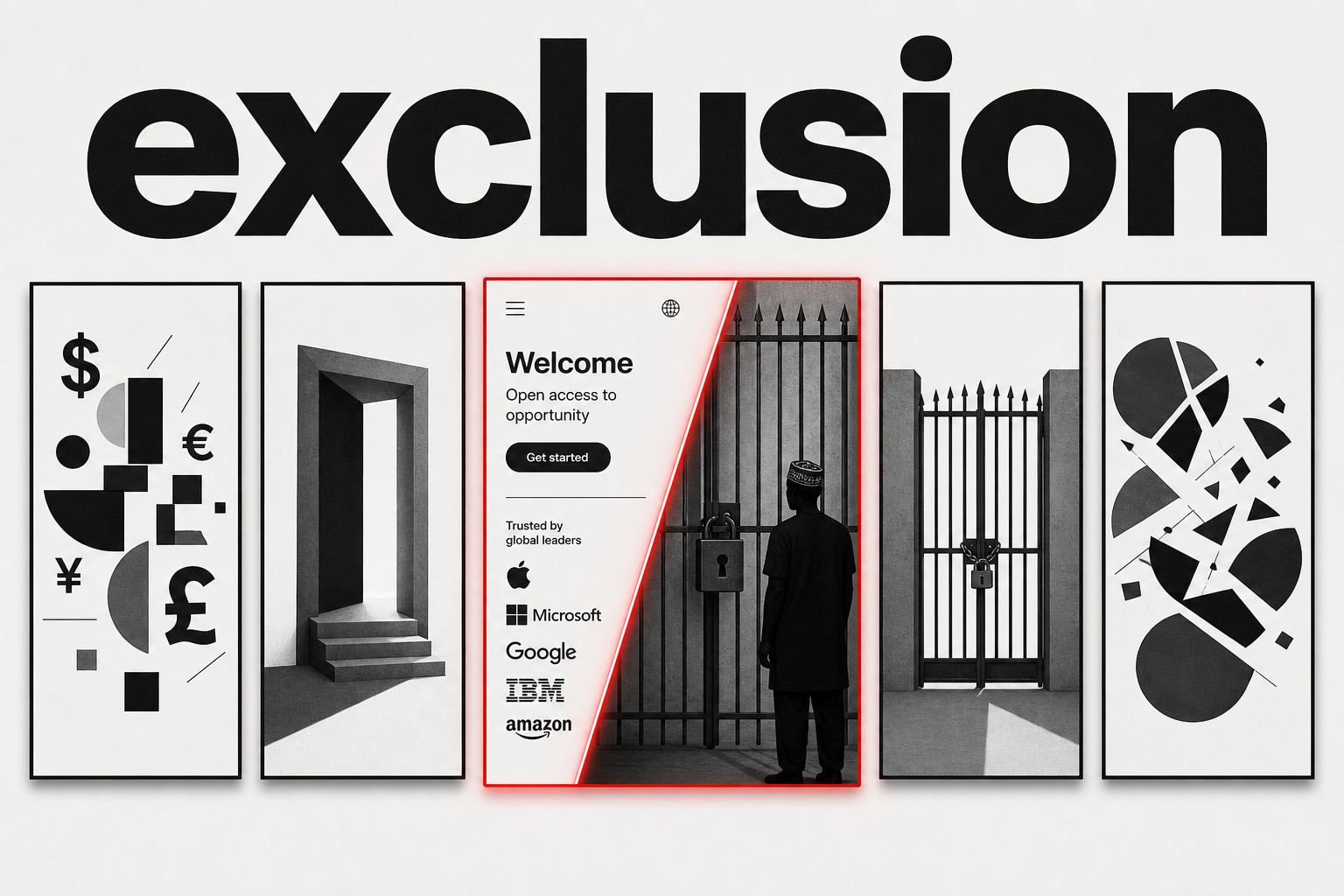
For over 20 years, PayPal locked Nigeria out. Not restricted, not limited. Locked out. Over 200 million people couldn’t receive payments through the world’s most popular online payment system. The official reason was fraud prevention, as if a country of 200 million people could be reduced to its worst actors. No graduated access. No regional safeguards. Just a door that never opened.
Stripe took years to support Nigerian payouts. GitHub Copilot charges the same $10 whether you’re in San Francisco or Surulere. SaaS tools ask for US-issued cards. AWS free tiers come with billing address restrictions. Cloud credits, startup grants, accelerator applications. All of them assume a US zip code.
The pattern is consistent: global platforms build for the world, then price for the West. The exclusion is rarely announced. It just is. You try to sign up and the dropdown doesn’t have your country. You try to pay and your card is declined, not because there’s no money on it, but because it was issued by a Nigerian bank.
So when Anthropic doubled its Nigerian pricing overnight last week, it wasn’t a new problem. It was the same problem wearing an AI company’s logo.
Claude Max, Anthropic’s premium plan, doubled in price. The 5x plan went from ₦100,000 to ₦200,000. The 20x plan jumped from ₦200,000 to ₦400,000. Even the entry-level Pro plan doubled, from ₦15,000 to ₦30,000.
No announcement. No explanation. Just new numbers.
I stared at the screen for a minute trying to make the math work. A $100 tier at ₦1,500 to the dollar is roughly ₦150,000. They’re charging ₦400,000. They are charging a market with significantly lower earning power nearly three times the actual dollar conversion. That’s not currency adjustment. That’s a decision.
The companies that got this right
Regional pricing isn’t a new idea. It’s not charity. It’s basic market logic: charge what people can pay, and you get millions of customers instead of dozens.
Spotify figured this out years ago. Premium costs ₦900 per month in Nigeria, roughly $0.60. The same plan costs $11 in the US. That’s not a loss leader. That’s understanding that a Nigerian listener paying ₦900 is better than a Nigerian listener pirating music because the alternative is unaffordable.
Netflix runs a mobile plan at ₦2,200 here. Apple Music charges ₦900 for students. These companies aren’t running charities. They’re building markets. They understand that Nigeria’s value isn’t in per-user revenue today, it’s in a hundred million potential subscribers over the next decade.
Anthropic looked at the same market, the same purchasing power data, the same economic reality, and went the other way.
What ₦400,000 actually means
It’s easy to read these numbers if you earn in dollars or pounds and think, okay, that’s expensive but manageable. Let me ground this.
Nigeria’s national minimum wage is ₦70,000 per month. The new Claude Max 20x plan costs nearly six times that. A mid-level software developer in Lagos earns between ₦300,000 and ₦600,000. The 20x plan is their entire salary or more. Even the entry-level Pro plan at ₦30,000 is approaching 50% of minimum wage.
Compare that to the US, where Claude Max costs $200 and the federal minimum wage is about $1,200 per month. That’s roughly 17% of minimum wage for the premium tier in America versus 570% in Nigeria.
When you price a tool at ₦400,000 per month, you are not selling access. You are deciding who gets to participate. You are saying: Nigerian developers, designers, founders, students, researchers. You don’t get to compete.
The pattern that won’t die
This isn’t about Anthropic specifically. It’s about an industry pattern that treats global markets as an afterthought.
Stripe took years to support Nigerian payouts. GitHub Copilot has no regional pricing. Many SaaS tools require US-issued cards. Firebase and AWS free tiers come with billing address restrictions that lock out entire countries. Cloud credits, startup programs, grant applications, all of them assume a US or European billing address.
The infrastructure of the internet was built on the assumption that users are in San Francisco. Decades later, we’re still paying for that assumption.
And the AI industry, the one that promises more loudly than anyone else that it will “democratize access” and “empower everyone,” has somehow made the problem worse. Every major AI lab charges by the token, a unit that costs exactly the same to serve whether the request comes from Lagos or London. But the access? That’s priced in dollars, billed to cards issued in countries with functioning banking systems, and wrapped in enterprise plans designed for companies with procurement departments.
This compounds the further back you are in your career. A junior designer in Lagos doesn’t just need to learn the craft. They need Figma, which costs $20 a month for a professional account, and soon, extra credits for AI features. They need a code editor, an AI coding assistant, probably a prototyping tool or two. These aren’t luxuries. In 2026, they’re table stakes. But every subscription assumes a currency where $20 is lunch money, not 5% of a starting salary. A generation of Western designers built careers on tools that were free or cheap at the point of entry. The next generation of Nigerian designers is being priced out before they write their first line of code.
The exclusion isn’t a side effect. It’s baked into the architecture.
”AI that serves humanity”
That’s Anthropic’s mission statement. It’s on their homepage. They are building AI systems, they say, that are helpful, honest, and harmless, designed to benefit all of humanity.
Humanity with a US billing address, apparently.
This is the contradiction at the heart of the AI industry in 2026. Every lab publishes papers about AI safety and equitable access. Every CEO gives interviews about empowering the next billion users. Every product page uses words like “accessible,” “inclusive,” and “for everyone.”
Then they set pricing that assumes a Bay Area salary.
I don’t think the people building these systems are lying about their intentions. I think they genuinely believe they’re building tools for everyone. But they are building them from rooms where nobody has ever had to choose between a tool subscription and rent. They are designing for the life they know.
The result is the same whether the intent is exclusion or indifference. The doors stay closed.
Why this matters beyond the price tag
You might read this and think, okay, so AI tools are expensive in Nigeria. So are iPhones. So are cars. That’s global economics.
But AI is not a consumer luxury. It is rapidly becoming infrastructure. Developers use it to learn new frameworks. Designers use it to iterate faster. Students use it to supplement under-resourced education systems. Founders use it to compete with companies that have ten times their resources.
In a market like Nigeria, where capital is scarce, networks are smaller, and institutional support is weak, AI tools are not conveniences. They are equalizers. Or they were supposed to be.
When you price Nigerian users out of access, you are not just charging more for a product. You are widening a gap that the product was meant to close.
What comes next
I don’t have a neat solution. I’m a product designer from Lagos, not a pricing strategist at a $60 billion AI company. But I know what good regional pricing looks like because I use products every day that get it right. I also know what happens when companies treat markets like mine as an afterthought: we build workarounds. We share accounts. We use VPNs. We find ways in because we have to.
But we shouldn’t have to.
The people building AI keep saying they want to change the world. The world is bigger than San Francisco, bigger than the US, bigger than any single currency zone. If the mission is real, the pricing should reflect it.
Until it does, every “democratize” in every press release is just a word. And every Nigerian founder, developer, and designer who can’t afford to compete is the proof.